

IA para E-commerce: Transform Your Online Business Today!
05
ago
Implementing AI in e-commerce significantly improves customer experiences by providing personalized recommendations, automating services through chatbots, and optimizing inventory management, which ultimately leads to increased sales and operational efficiency.
IA para e-commerce is reshaping the landscape of online retail.
By integrating advanced technologies, businesses can enhance customer interactions, streamline operations, and increase sales significantly.
In this article, we will uncover the various aspects of IA in the e-commerce sector, its advantages, and practical steps to implement these innovative solutions in your online business.
What is IA for E-commerce?
IA for e-commerce refers to the use of Artificial Intelligence technologies to enhance online shopping experiences.
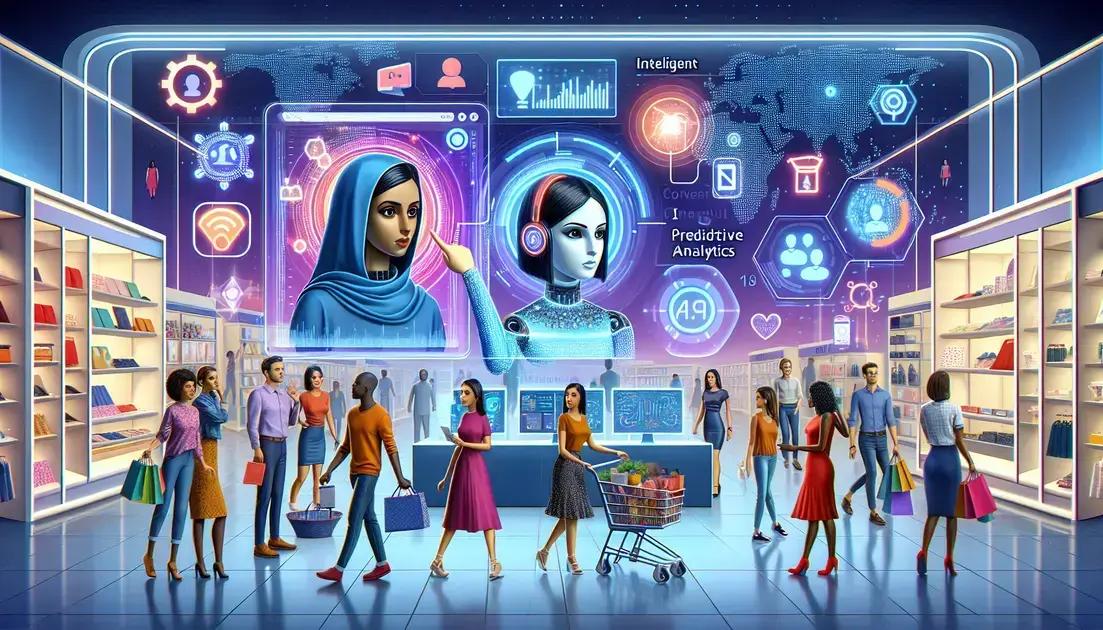
It encompasses a variety of applications, such as chatbots, personalized recommendations, and predictive analytics.
By leveraging data, e-commerce platforms can understand customer behavior better, allowing them to tailor their offerings accordingly.
This not only improves customer satisfaction but also drives sales.
Moreover, IA can help businesses analyze vast amounts of data to predict trends and optimize inventory, making operations more efficient.
Benefits of Using IA in E-commerce
Benefits of Using IA in E-commerce are vast and transformative. First, AI enhances customer experience through personalization. By analyzing user behavior, e-commerce platforms can tailor recommendations, making shopping more relevant and enjoyable for each customer. Additionally, AI can automate customer service with chatbots, providing instant support without human intervention. This reduces the workload on staff and improves response times.
Another significant benefit is the ability to predict trends using data analytics. E-commerce businesses can foresee customer demands and adjust inventory accordingly, which minimizes stocks and maximizes sales. Moreover, AI helps in optimizing pricing strategies based on market conditions, competitors’ prices, and customer purchasing patterns.
AI can also enhance marketing campaigns through targeted advertising. By understanding user preferences, businesses can create more effective ads that reach the right audience at the right time. Ultimately, the integration of IA not only leads to increased sales but also fosters customer loyalty by developing a more engaging shopping experience.
Implementing IA Solutions in Your Online Store
Implementing IA Solutions in Your Online Store requires a structured approach. Start by identifying key areas where AI can deliver value, such as customer service, marketing, or inventory management. Choose the right tools and technologies that align with your business needs and ensure they integrate well with your existing systems.
Next, consider conducting pilot projects to test AI solutions on a smaller scale. This allows you to measure effectiveness and make adjustments before a full-scale implementation. Training your team is crucial; provide them with the knowledge to utilize AI tools efficiently and understand the resulting insights.
Additionally, monitor the performance metrics regularly to evaluate what works best. Use feedback to refine processes continually. As customer expectations evolve, staying agile and responsive to their needs with AI solutions can greatly enhance your store’s competitive advantage.
Future Trends of IA in E-commerce
Future Trends of IA in E-commerce are shaping the way online businesses operate. As technology evolves, we can expect more personalized shopping experiences, integrating AI deeper into customer interactions. Machine learning algorithms will continue to improve, enabling e-commerce platforms to predict consumer behavior with greater accuracy.
One significant trend is the rise of voice commerce, where AI will facilitate shopping through voice recognition, making it easier for customers to make purchases without using a screen. Another trend is the use of augmented reality (AR) combined with AI to provide virtual try-ons, improving customer engagement and satisfaction.
Moreover, AI will play a crucial role in supply chain optimization. By analyzing data and identifying patterns, businesses can enhance inventory management and reduce costs. As we move forward, embracing these innovations will be vital for staying competitive in the ever-evolving e-commerce landscape.
Case Studies: Successful IA Applications in E-commerce
Case Studies: Successful IA Applications in E-commerce highlight how businesses use Artificial Intelligence to improve their operations.
One great example is Amazon, which employs AI for its recommendation systems. These systems analyze customer behavior and preferences to suggest products that customers may love, leading to increased sales.
Another case is Sephora, which utilizes chatbot technology to enhance customer service. Customers can ask for product recommendations and receive instant responses, creating a seamless shopping experience. This reduces wait times and empowers customers to make informed purchases.
Moreover, Walmart implements AI in inventory management. By predicting demand through data analysis, they can optimize stock levels, reducing costs and ensuring that popular items are always available.
These case studies demonstrate that integrating AI while remaining attentive to customer needs can lead to significant advantages in e-commerce.
In Conclusion: Embracing AI in E-commerce
Adopting Artificial Intelligence (AI) in e-commerce is no longer optional; it is essential for staying competitive. The benefits, from enhanced customer experiences to streamlined operations, are clear.
As explored, successful implementations can lead to significant improvements in sales, efficiency, and customer satisfaction.
Businesses should approach AI integration thoughtfully, starting with assessments of their needs and capabilities. Pilot programs can offer valuable insights into what works best for their specific context.
As we look ahead, the advancements in AI technologies will continue to reshape the e-commerce landscape. By embracing these changes, businesses can thrive and build stronger connections with customers.
Remember, the future of e-commerce lies in innovation, and AI is a key component of that journey.